

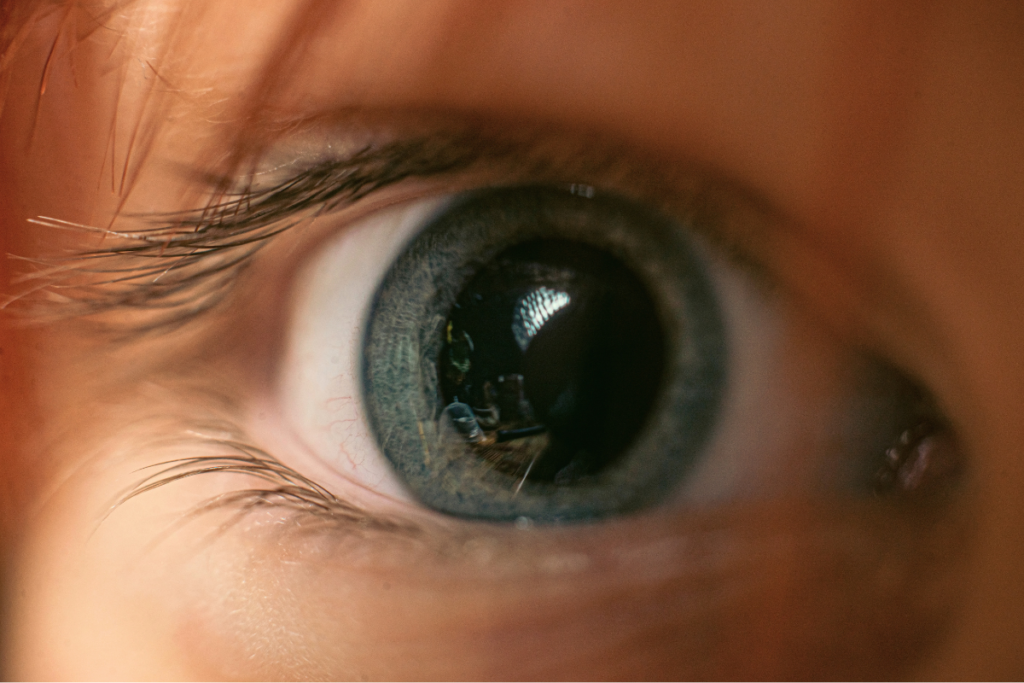
If you’ve been to the eye doctor recently, you may have been given a choice: Would you like retinal imaging, or would you prefer to have your eyes dilated?
At first, these can sound like two different ways of doing the same thing. Both help your eye doctor evaluate the health of the inside of your eyes, so why would you choose one over the other? And if you have retinal imaging, does that mean you never need dilation?
Not exactly.
When comparing retinal imaging vs. dilation, the most important thing to understand is that they aren’t interchangeable. Retinal imaging gives us a detailed photograph that we can document and compare over time, while dilation allows us to physically examine areas inside the eye that may not be captured adequately in a photograph.
For many routine eye exams, retinal imaging gives us an excellent look at your eye health without the inconvenience of dilated pupils. But there are also situations where a dilated eye exam is still the better choice, or where we may recommend dilation even after taking retinal images.
Here’s how the two compare.
What Is Retinal Imaging?
Retinal imaging uses a specialized camera to take a high-resolution photograph of the back of your eye.
Your retina is the light-sensitive tissue lining the inside of the eye. It plays an essential role in vision, but it can also give us clues about your overall health.
During a retinal imaging eye exam, you simply look into the camera while the image is taken. It only takes a few seconds, and nothing touches your eye.
The resulting image allows us to look closely at structures including your retina, optic nerve, macula, and blood vessels.
You may also hear this referred to as retinal photography or a retinal photo.
One of the biggest advantages of retinal photography is that the image becomes part of your record. That means we can compare this year’s image with one taken next year, or several years from now.
Sometimes a tiny change is much easier to recognize when we can put two images side by side.
RELATED CONTENT: Why Eye Doctors Use OCT Scans
Does Insurance Cover Retinal Imaging?
Most of the time, no. Routine screening images aren’t usually covered by vision or medical insurance. So, this fee is typically paid out of pocket.
If retinal imaging is medically necessary to evaluate or monitor an eye condition, insurance coverage may be different depending on your plan.
What Does Eye Dilation Do?
Dilation works differently. During eye dilation, we place drops in your eyes that temporarily make your pupils larger. It usually takes a little time for the drops to fully take effect.
While dilation doesn’t hurt, it does leave your eyes very sensitive to light. Which is why many patients leave in those recognizable shades.
So, why do eye doctors dilate your eyes?
Normally, your pupil gets smaller when light shines into it. That’s helpful in everyday life, but it makes looking through the pupil and examining the inside of your eye more difficult.
Dilation keeps the pupil open wider so we can use lenses and specialized instruments to examine the retina and other structures inside your eye.
Unlike retinal imaging, we’re not simply looking at a photograph. We’re examining the eye directly and can change our angle, focus, and view as we look at different areas.
That’s one reason a retinal exam performed through a dilated pupil can still be important even when excellent retinal images are available.
How Long Does Eye Dilation Last?
One downside of dilation is that the effects don’t disappear as soon as your exam is over. For most adults, the effects typically last several hours, although the exact amount of time varies from person to person.
While your pupils are dilated, you may notice that bright lights feel much more intense. Near vision can also become blurry, making it harder to read or look at your phone.
Your distance vision may be less affected, but that doesn’t necessarily mean everything will feel completely normal.
Sunglasses can make the light sensitivity much more comfortable while you wait for the drops to wear off.
Can You Drive After Eye Dilation?
Many people are able to drive after being dilated. However, it depends on how your eyes respond to the drops and how comfortable you feel with your vision. Bright sunlight can be especially uncomfortable, and some people experience more blur than others.
If you’ve never had your eyes dilated before, it may be a good idea to have someone available to drive you home. And if your vision doesn’t feel clear enough to drive safely, don’t drive until the effects have worn off.
Retinal Imaging vs. Dilated Eye Exam: Which Is Better?
When comparing retinal imaging vs. dilated eye exam, each has advantages.
Retinal imaging is quick, comfortable, and provides a permanent image we can refer back to. It also doesn’t leave you with blurry near vision or increased sensitivity to light afterward.
Dilation, however, allows your eye doctor to look around inside the eye in real time. We can adjust our view to investigate something suspicious and may be able to see areas that aren’t adequately captured by a retinal photograph.
Think of it this way: a retinal image gives us an excellent photograph of the inside of your eye. Dilation opens the door wider so we can look around ourselves.
Both can tell us a lot. They just do it differently.
Does Retinal Imaging Replace Dilation?
Sometimes retinal imaging provides all of the information we need during a routine exam, and dilation isn’t necessary that day. But retinal imaging doesn’t completely eliminate the need for dilation.
If we notice something concerning on your retinal image, dilation may actually be the next step.
We may also recommend dilation based on your symptoms, medical history, risk factors, or something we see during another part of your exam.
For example, if you’re suddenly experiencing new flashes or floaters, we may want a more complete view of the peripheral retina to look for a retinal tear or other problem. In a situation like that, taking a retinal photograph alone may not be enough.
So even if you choose imaging, there is always a possibility that we will recommend dilation if it’s medically necessary.
Why Do We Often Recommend Retinal Imaging?
For routine eye care, there are several reasons we like retinal imaging.
First, it’s fast. The actual image takes only seconds to capture, and you can continue with your day immediately afterward.
Second, it gives us documentation. Your eyes can change slowly over time, and those changes aren’t always obvious from one exam to the next. Having previous retinal images available allows us to look back and see whether something has actually changed.
Retinal imaging can also help document findings related to conditions such as diabetes, glaucoma, macular degeneration, and other retinal or optic nerve problems.
And there’s another benefit we really like: you get to see it too.
Instead of us simply telling you that your optic nerve or retina looks healthy, we can pull up the image and show you what we’re seeing. If there’s an area we’re watching, we can point it out and explain why it matters.
Is Retinal Imaging Worth It?
Dilation is often covered as part of a patient’s vision or medical benefits. So why would someone choose to pay for imaging instead?
While retinal imaging is usually an out-of-pocket expense, we think it’s worth it for many patients.
At Emerald Point Eye Care, the retinal imaging cost is minimal. And it is optional for most routine exams.
Additionally, retinal imaging doesn’t leave your pupils dilated for several hours. And you don’t have to deal with the temporary light sensitivity or blurry near vision that can come with dilation.
But the image itself also has value. It gives us a detailed baseline that becomes part of your record and can be compared at future visits.
So, Which One Should You Choose?
If you’re coming in for a routine comprehensive eye exam, we offer you the choice between retinal imaging and dilation. We generally recommend retinal imaging because it’s quick, comfortable, and gives us a permanent picture of your retinal health that we can use for comparison in the future.
But choosing imaging doesn’t mean we’re promising that you’ll never need to be dilated.
If your symptoms, health history, or something we see during your exam makes dilation the better option, we’ll explain why we recommend it. And sometimes, the most useful answer isn’t imaging or dilation. It’s both.
At Emerald Point Eye Care, our goal isn’t simply to check a box that says we looked at your retina. We want to use the method that gives us the information we need while making your eye exam as comfortable and convenient as possible.
And if you’re not sure which option makes the most sense for you, just ask. We’re always happy to walk you through it.