

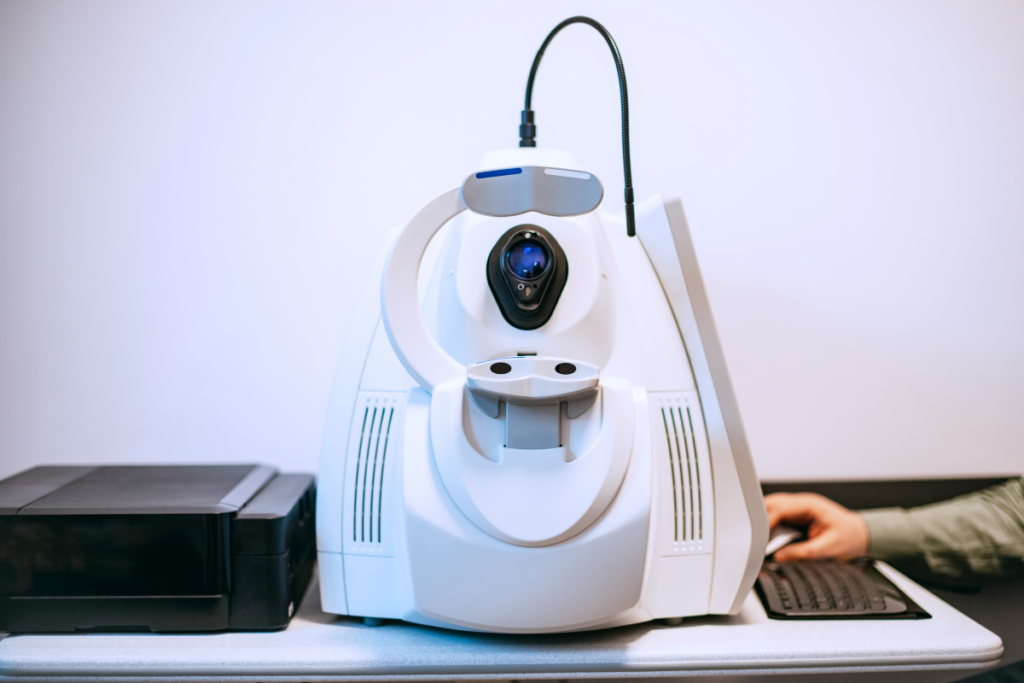
If you’ve had an eye exam in the last few years, there’s a good chance your eye doctor recommended an OCT scan. Patients often ask me, “What exactly is this test?” or “Do I really need it if my vision seems fine?”
The short answer is yes, in many cases. OCT scans allow us to see eye disease earlier, track subtle changes over time, and protect vision long before symptoms appear. And the best part? The test is quick, painless, and incredibly detailed.
Let’s break down what OCT scans are, why eye doctors rely on them, and what they can reveal about your eye health.
What Is an OCT Scan?
OCT stands for Optical Coherence Tomography. Think of it as an ultrasound for your eyes, but instead of sound waves, it uses light waves to create high-resolution images of your eye’s internal structures.
An OCT scan produces detailed cross-section images of the retina, optic nerve, and surrounding tissues. These images allow us to see individual layers of the retina, which is critical because many eye diseases begin beneath the surface, long before they affect vision.
The scan itself takes only a few seconds per eye. You simply look at a target light while the machine captures images. There’s no contact with your eye, no puff of air, no eye dilation, no injections, and no recovery time.
Why OCT Scans Are So Important in Eye Care
Traditional eye exams are still essential, but they have limitations. Even with a dilated exam, we’re viewing the eye from the surface inward. OCT allows us to see microscopic changes inside the eye that the human eye alone can’t detect.
Here’s why OCT has become a standard tool in modern eye care:
- It detects disease earlier than symptoms appear
- It helps confirm or rule out serious eye conditions
- It tracks progression over time with precise measurements
- It guides treatment decisions with objective data
In many cases, OCT scans help us catch problems years earlier than we could in the past.
What Conditions Can OCT Scans Detect?
OCT imaging plays a major role in diagnosing and managing several common and serious eye conditions.
Glaucoma
Glaucoma damages the optic nerve slowly and often without noticeable symptoms until vision loss is advanced. OCT allows us to measure the thickness of the nerve fiber layer around the optic nerve.
Thinning in these layers can indicate glaucoma before vision is affected, making early treatment possible and helping preserve sight.
RELATED CONTENT: Why Glaucoma Doesn’t Have Any Symptoms & How We Find It
Macular Degeneration
The macula is responsible for sharp, central vision. OCT scans can detect early structural changes in the macula, fluid buildup, or damage associated with macular degeneration.
For patients with macular degeneration, OCT helps us monitor progression and determine when treatment is necessary.
Diabetic Eye Disease
Diabetes can cause swelling, fluid leakage, and damage to the retina. OCT imaging is one of the most accurate ways to detect diabetic macular edema and other retinal changes caused by diabetes.
Often, these changes occur before a patient notices blurred vision, which is why routine OCT scans are so valuable for people with diabetes.
RELATED CONTENT: Understanding Diabetic Eye Diseases
Retinal Conditions
OCT scans can identify:
- Retinal tears or thinning
- Macular holes
- Epiretinal membranes
- Vitreomacular traction
These conditions may cause subtle visual distortion or no symptoms at all in early stages.
Why OCT Scans Are Useful Even If Your Vision Seems Fine
One of the most common misconceptions I hear is, “My vision is good, so my eyes must be healthy.”
Unfortunately, many eye diseases don’t affect vision right away. By the time vision changes are noticeable, damage may already be permanent.
OCT scans help us:
- Establish a baseline for future comparison
- Identify risk factors early
- Monitor small changes that wouldn’t be noticeable otherwise
This is especially important for patients with a family history of glaucoma, macular degeneration, or diabetes.
How OCT Systems Help Track Changes Over Time
One of OCT’s greatest strengths is its ability to compare scans year over year. The software allows us to measure microscopic changes in retinal thickness and optic nerve structure with incredible precision.
This helps answer important questions like:
- Is this condition stable or progressing?
- Is treatment working?
- Do we need to adjust management plans?
Rather than relying solely on symptoms or visual field tests, OCT provides objective data that guides clinical decisions.
Is an OCT Scan Safe?
Yes. OCT scans are extremely safe and noninvasive. They do not use radiation, and there is no contact with the eye. The technology relies on harmless light waves to generate images.
Most patients find the test quick and comfortable, even those who are sensitive to other eye tests. I recommend this scan for every patient during their regular eye exams.
Does Insurance Cover OCT Scans?
Coverage depends on your insurance plan and the reason for the scan. OCT scans are typically covered when they are medically necessary, such as for monitoring glaucoma, macular degeneration, or diabetic eye disease.
In some cases, OCT may be recommended as an advanced screening tool. Our team always explains coverage and costs ahead of time so there are no surprises.
The Bottom Line
OCT scans have transformed how eye doctors detect and manage eye disease. They allow us to see what’s happening beneath the surface, catch problems earlier, and protect vision more effectively than ever before.
If your eye doctor recommends an OCT scan, it’s not about running unnecessary tests. It’s about using the best tools available to safeguard your long-term eye health.
If you have questions about OCT imaging or whether it’s right for you, we’re always happy to talk it through during your exam.