
When most people picture an eye exam, they think of the classic “Which is better—1 or 2?” test. But modern optometry has come a long way since the days of simple vision charts and handheld lenses. Today’s eye exams rely on advanced technology that helps us see what you can’t see, deep inside the structures of your eyes.
These innovations allow us to catch problems earlier, diagnose with greater precision, and personalize your vision correction better than ever before. Take a peek behind the curtain at the high-tech tools that power your modern eye exam.
Digital Refraction Systems
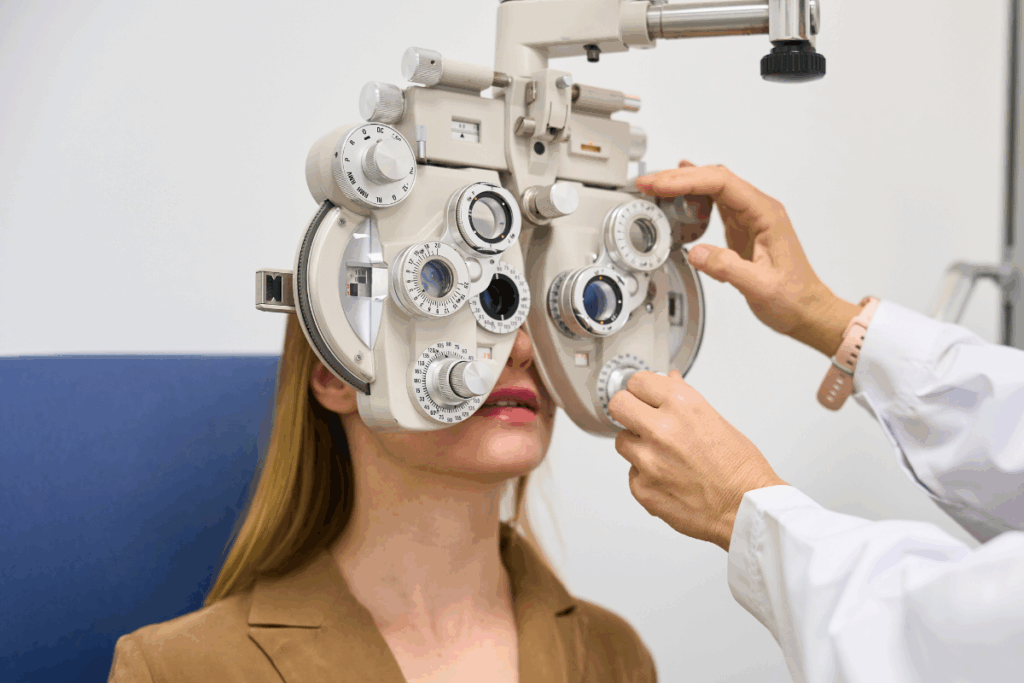
That “1 or 2” test is still around, but it’s smarter now. Many eye exams now use digital phoropters, which are automated systems that switch between lens options with incredible accuracy. The result is quicker, more precise prescriptions and an easier experience for you. So no guessing between barely-different lenses.
Some systems even link directly to your patient record, ensuring seamless updates to your prescription and easier comparisons between visits. It’s one of the ways we make sure your glasses or contact lenses are truly dialed in for how you see.
Retinal Imaging (Fundus Photography)
Your retina, which is the light-sensitive layer at the back of your eye, tells us a lot about your overall health.
With digital retinal imaging, we can capture detailed, high-resolution photos of the inside of your eye in seconds. This technology helps us detect early signs of conditions like:
- Diabetic retinopathy
- Glaucoma
- Macular degeneration
- Hypertension-related changes
Best of all, we can save these images and compare them over time. Think of it as a visual health history, like tracking your eyes’ story year after year.
Optical Coherence Tomography (OCT)
This is one of the most powerful diagnostic tools in modern eye care. OCT imaging works a bit like an ultrasound, except it uses light waves instead of sound waves. The result is a cross-sectional view of your retina, showing each distinct layer in incredible detail.
Many serious eye diseases begin beneath the surface, long before you notice any vision changes. OCT allows us to spot those subtle shifts early, often before permanent damage occurs. For patients with glaucoma, diabetic eye disease, or macular degeneration, this tool can be truly vision-saving.
Corneal Topography
Your cornea (the clear front surface of your eye) plays a major role in how you see. Corneal topography maps its shape in fine detail, giving us a “landscape” of your eye’s curvature.
This technology helps us:
- Fit specialty contact lenses
- Plan for laser vision correction
- Diagnose and monitor keratoconus (a condition where the cornea thins and bulges)
The result? More precise fittings and sharper vision, especially for patients who’ve struggled with comfort or clarity in the past.
Autorefractors & Wavefront Analyzers
Before your doctor even picks up the phoropter, autorefractors and wavefront analyzers use light reflections to measure how your eye focuses.
These pieces of eye exam equipment give a starting point for your prescription. They also help identify subtle optical imperfections (called higher-order aberrations) that can affect night vision or clarity.
It’s part of why modern prescriptions are more accurate, and why today’s lenses can correct vision more precisely than ever before.
Visual Field Testing
Vision isn’t just about how clearly you see. It’s also about how wide you can see.
Visual field tests map your peripheral (side) vision and help detect early signs of glaucoma or neurological issues. Advanced automated systems track your responses and create detailed maps of your field of vision, making it easy to spot even the tiniest blind spots.
Tear Film & Dry Eye Analysis
If your eyes feel gritty, watery, or tired, today’s technology can uncover why. We now have noninvasive tear film analyzers and meibography imaging that show how well your tear glands function. These tools let us pinpoint the cause of dry eye — whether it’s related to oil gland blockage, tear quality, or inflammation. This insight helps us recommend personalized treatments instead of one-size-fits-all solutions.
The Human Touch Still Matters
Even with all this technology, the heart of a great eye exam hasn’t changed: a conversation. These tools help us see the data. But it’s your story — how your eyes feel at the end of the day, how your vision changes at night, what you do for work or hobbies — that completes the picture. Technology gives us the information, but your input gives it meaning.
Your Eyes Deserve Modern Care
At Emerald Point Eye Care, we invest in technology because it helps us take better care of you. From digital imaging to advanced diagnostics, every tool in our office is chosen to make your exam more comfortable, more precise, and more informative.
If it’s been a while since your last comprehensive eye exam, now’s a great time to experience what modern eye care can do. Your future vision will thank you.