

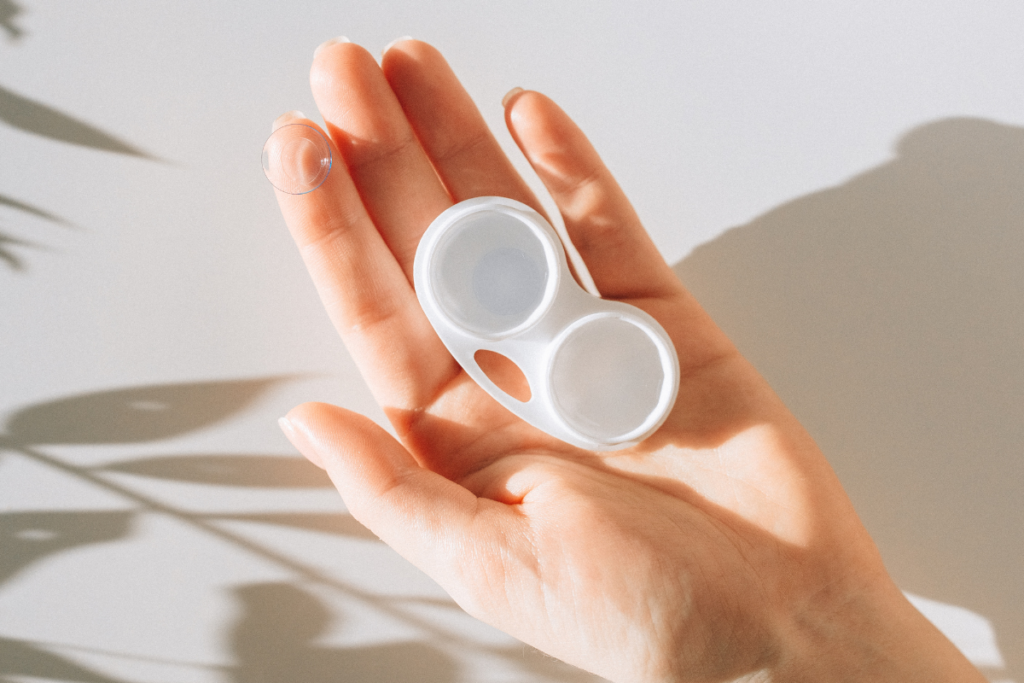
If you wear contact lenses, there’s a good chance you wear soft contacts. They’re comfortable, convenient, and by far the most common type of contact lens today.
So, you might be surprised if your eye doctor recommends hard contact lenses instead.
Hard contacts are still very much around, although modern versions are quite different from the hard lenses people wore decades ago. Known as rigid gas permeable contact lenses, or RGP contact lenses, they can offer incredibly crisp vision and may be a better choice for certain prescriptions or corneal conditions.
So, when comparing hard vs. soft contact lenses, which is better? The answer depends on your eyes.
Here’s how hard contacts vs. soft contacts compare when it comes to comfort, vision, astigmatism, cost, care, and more.
What Are Hard Contact Lenses?
First, when we talk about hard contact lenses today, we generally mean rigid gas permeable lenses.
Older hard contacts were made from a material called PMMA. They did not allow oxygen to pass through the lens. Modern RGP lenses are made from oxygen-permeable materials, making them much healthier for the cornea.
Unlike soft contact lenses, which are flexible and conform to the surface of the eye, RGP contacts maintain their shape when you put them on.
That difference affects everything from how the contacts feel to the quality of vision they can provide.
RELATED CONTENT: How Contact Lens Materials Have Evolved for Comfort & Clarity
Are Scleral Lenses Hard Contacts?
Scleral lenses are made from rigid gas permeable materials, so they are technically a type of rigid contact lens. However, they’re very different from the traditional RGP contacts most people mean when they talk about “hard contacts.”
Traditional RGP lenses are relatively small and sit on the cornea. Scleral contact lenses are much larger. They vault over the cornea and rest on the sclera, or white portion of the eye.
That unique design can make scleral lenses an excellent option for certain patients with keratoconus, irregular corneas, severe dry eye, or other complex eye conditions.
Hard vs. Soft Contacts: Which Is More Comfortable?
When it comes to immediate comfort, soft contact lenses generally have the advantage.
Soft contacts are thin and flexible, allowing them to conform closely to the eye. Most people adjust to them very quickly, and some barely notice they’re wearing contacts at all.
So, are hard contact lenses comfortable? They certainly can be, but they usually take longer to get used to.
Because an RGP lens is rigid and typically smaller than a soft lens, you may be more aware of it when you first begin wearing it. Your eyelids and eyes need time to adapt. With consistent wear, many longtime RGP wearers become very comfortable in their lenses.
However, if you’re looking for a contact lens you can wear occasionally without much adjustment, soft contacts are often the easier option.
Do Hard Contacts Provide Better Vision Than Soft Contacts?
This is where hard contact lenses have a major advantage for certain patients.
Soft contact lenses conform to the shape of the cornea. RGP contact lenses maintain a smooth, rigid surface over it.
The tear layer that forms between an RGP lens and the cornea can help compensate for irregularities in the corneal surface. This creates a smoother optical surface for light to pass through and can result in extremely crisp vision.
Does that mean hard contacts always provide better vision? No. Someone with a straightforward prescription may see just as well with soft contacts. But for people with certain types of astigmatism, irregular corneas, keratoconus, or more complicated prescriptions, RGP lenses may provide clearer, more consistent vision than soft lenses.
Are Hard Contacts Better for Astigmatism?
When comparing hard vs. soft contacts for astigmatism, there’s no universal winner. Your corneal shape, prescription, comfort, and visual needs all help determine which lens is best.
Soft toric contact lenses are specifically designed to correct astigmatism and work very well for many people. If you’re comfortable in toric contacts and seeing clearly, there’s usually no reason to switch simply because you have astigmatism.
However, RGP contact lenses correct vision differently. Because the rigid lens maintains its shape over the cornea, it can create a smooth refractive surface rather than conforming completely to an irregular corneal shape. For patients with higher or irregular astigmatism, this can produce sharper vision.
How Long Do Hard Contacts Last?
This is another significant difference between hard and soft contact lenses.
Most soft contacts follow a set replacement schedule. Depending on the lens, you might throw them away every day, every two weeks, or every month.
RGP lenses are much more durable. With proper cleaning, handling, and care, a pair of rigid gas permeable contact lenses can often last a year or longer.
That doesn’t mean you should simply keep wearing an old pair indefinitely. Your prescription can change, lenses can become scratched or damaged, and the fit of your contacts should be evaluated regularly.
But compared with soft lenses, hard contacts generally have a much longer lifespan.
Which Type of Contact Lens Is Easier to Care For?
This one depends heavily on which soft contacts you’re comparing.
Daily disposable soft contacts are about as easy as it gets. You put in a fresh pair in the morning, remove them at night, and throw them away. There’s no cleaning or storage required.
Reusable soft contacts and RGP lenses both require a consistent cleaning and disinfection routine.
Hard contacts are durable, but they still need to be handled carefully. Your eye doctor will give you specific instructions for cleaning, storing, inserting, and removing your lenses.
Regardless of whether you choose hard or soft contact lenses, good contact lens hygiene is essential for protecting your eyes from irritation and infection.
RELATED CONTENT: Guide to the Types of Contact Lenses
Are Hard Contact Lenses More Expensive?
Hard contact lens cost isn’t quite as simple as comparing the price of one box of contacts with another.
RGP contact lenses typically have a higher upfront cost because they’re individually fitted and designed to last much longer. Soft contacts generally cost less per lens, but you continuously replace them throughout the year.
Your total cost will depend on the specific lens, how often it needs to be replaced, your prescription, and how frequently you wear contacts.
Specialty rigid lenses can also cost considerably more than conventional contacts because of the additional measurements, customization, and fitting involved.
For that reason, it’s better to compare the overall cost of wearing the lenses rather than just the initial price.
Who Should Consider RGP Contact Lenses?
Most people don’t need to switch from soft contacts to hard contacts. Soft lenses provide excellent comfort and vision for millions of people.
However, your eye doctor may recommend RGP contact lenses if you:
- Have higher or irregular astigmatism
- Have an irregularly shaped cornea
- Have keratoconus
- Have difficulty achieving clear, stable vision with soft contacts
- Have certain corneal conditions
- Have had certain types of corneal surgery
- Want especially crisp vision and are willing to go through an adaptation period
A contact lens exam allows your eye doctor to evaluate more than your prescription. We also look at your corneal shape, eye health, tear film, lifestyle, and how a lens actually sits and moves on your eye.
RELATED CONTENT: Guide to Ortho-K Contact Lenses
Final Thoughts: Are Hard Contacts Better Than Soft Contacts?
If you’re wondering are hard contacts better than soft contacts, the answer is: sometimes.
Soft contacts are popular for a reason. They’re comfortable, convenient, easy to adapt to, and available for a wide variety of prescriptions. For many people, they’re exactly what we would recommend.
But hard contacts shouldn’t be dismissed as an outdated option. Modern rigid gas permeable contact lenses can provide incredibly sharp vision, last significantly longer than disposable soft contacts, and work especially well for certain prescriptions and corneal shapes.
The best choice depends on your eyes.
At Emerald Point Eye Care, we fit both traditional and specialty contact lenses. If you’re struggling with blurry vision, uncomfortable contacts, astigmatism, or a difficult-to-fit prescription, a contact lens exam can help us determine what contacts make the most sense for you.