

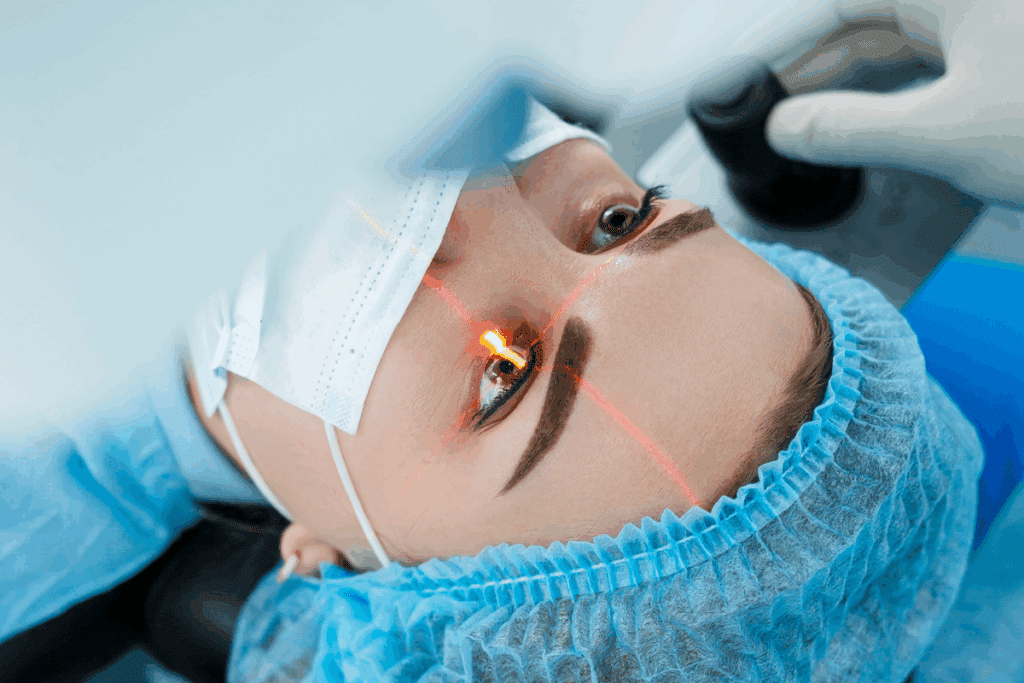
If you’ve ever wished you could wake up and see clearly without reaching for glasses or contacts, you’re not alone. Refractive eye surgery (often called laser eye surgery) has made that dream a reality for millions of people.
But while it’s an amazing technology, it’s also not one-size-fits-all. There are several different types of laser procedures, each with unique benefits, risks, and recovery times.
As an optometrist, I don’t perform these surgeries myself. But I do help patients figure out whether they’re good candidates, refer them to trusted local surgeons, and provide all the post-operative care.
Each type of refractive surgery works a little differently but has the same goal: to change the shape of the cornea and improve how light focuses on the retina. Explore the most common types of laser eye surgery and what to expect before, during, and after.
1. LASIK
What is it: LASIK (laser-assisted in situ keratomileusis) is the most well-known and widely performed type of laser vision correction. During LASIK, a surgeon creates a thin flap in the cornea (the clear front part of your eye). Then they use a laser to reshape the underlying tissue. The flap is then repositioned, acting like a natural bandage.
Best for: People with mild to moderate nearsightedness (myopia), farsightedness (hyperopia), or astigmatism.
Recovery: Most patients notice dramatically clearer vision within 24–48 hours, with minimal discomfort.
As your optometrist: I help determine whether your corneas are thick enough for LASIK and check for dry eye or other conditions that could affect healing. After surgery, I monitor your recovery to ensure the cornea heals properly and your vision stays stable.
2. PRK
What it is: PRK (photorefractive keratectomy) was actually the first laser vision correction procedure. And it’s still a great option for certain patients today. Instead of creating a corneal flap like LASIK, PRK removes the thin outer layer of the cornea entirely, then reshapes the surface with a laser.
Best for: People with thin corneas, or those who may not be good candidates for LASIK. For example, if you play contact sports or have a physically demanding job, where eye trauma is a risk.
Recovery: PRK takes a bit longer to heal. Vision may be blurry for several days to a week as the cornea regenerates its surface cells. Your eyes may also burn for about a week. But the long-term results are just as good as LASIK.
Our role in your care: We’ll help you understand whether PRK is a better fit for your eye shape and lifestyle. We will guide you through recovery once your surgeon completes the procedure.
3. SMILE
What it is: SMILE (small-incision lenticule extraction) is the newest FDA-approved form of laser vision correction. Instead of creating a flap, a laser removes a tiny disc of tissue (called a lenticule) through a small incision, changing the cornea’s shape.
Best for: Mild to moderate nearsightedness and astigmatism.
Recovery: SMILE offers faster healing than PRK and slightly less risk of dry eye than LASIK because fewer corneal nerves are disturbed. Most patients can return to normal activities within a day or two.
How your optometrist helps: We’ll evaluate whether your prescription and corneal health make you a good SMILE candidate. We’ll continue your follow-up exams to track healing and visual results.
4. LASEK
What it is: LASEK (laser-assisted sub-epithelial keratectomy) is a hybrid between LASIK and PRK. Instead of removing the surface layer of the cornea entirely, the surgeon loosens it with an alcohol solution, folds it back, performs the laser reshaping, and then replaces the tissue.
Best for: Patients with thin corneas who might not qualify for LASIK but want a faster recovery than PRK.
Recovery: You’ll likely experience mild discomfort for a few days, and your vision improves gradually over a week or two.
Our part: We’ll handle your follow-up care and monitor for any inflammation or haze during the healing period — both are rare but treatable if caught early.
5. Advanced Surface Ablation
What it is: Advanced surface ablation (ASA) is a broad term that includes PRK and other surface-based techniques. It’s often chosen for people with irregular corneas or other eye health considerations where creating a flap (as in LASIK) isn’t ideal.
Best for: People with unique corneal conditions or those seeking the safest long-term approach for active lifestyles.
Recovery: Recovery mirrors PRK — slower initially, but excellent long-term vision quality.
Post-op partnership: We’ll see you for a series of follow-up visits to check corneal healing, assess your comfort, and fine-tune any vision changes that occur during the recovery process.
Which Refractive Eye Surgery Is Right for You?
Every eye is unique. That’s why we start with a comprehensive eye exam to map your corneal curvature, measure your prescription, and evaluate the overall health of your eyes.
From there, we’ll discuss your lifestyle and visual goals. For some patients, laser surgery can reduce or even eliminate the need for corrective lenses. For others, it may not be the safest or most effective route.
You may not be a good candidate for these refractive eye surgeries if you:
- Have chronic dry eye
- Have thin corneas
- Experience frequent prescription changes
- Are younger than your mid-20s or have other eye health risks
- Have a history of herpes or other corneal infections
- Have a prescription that’s too high for safe laser correction
If laser surgery is a good option, we’ll connect you with trusted Boise eye surgeons we know and work closely with. After surgery, you’ll return to us for all of your post-operative care, including managing dryness, checking corneal healing, and ensuring your vision stabilizes as expected.
The Bottom Line
Laser eye surgery can be life-changing, but it’s not a decision to rush. Take time to understand the different types of procedures, what they treat, and how recovery may look for you.
An experienced optometrist can help guide that decision, making sure your eyes are healthy enough for surgery and that you’re connected with the right specialists for your needs.
Even if you never choose surgery, learning about your options is an empowering way to care for your vision long-term.