

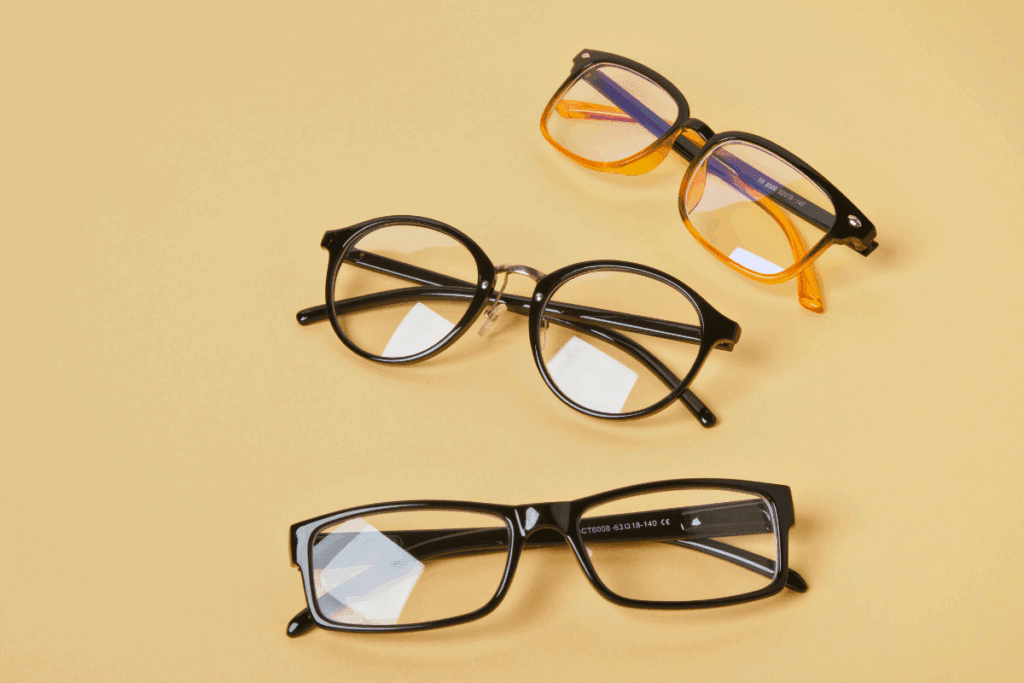
Lenses are the heart of your glasses. They do more than just correct your vision; they protect your eyes, reduce glare, and can be customized to fit your unique lifestyle. With so many options available for materials and coatings, choosing the right one can feel overwhelming.
The best lenses are a blend of your prescription, your daily habits, and your comfort. Discover the right type of lenses for your glasses in our quick guide.
Lenses for Vision Correction
Every prescription starts with a base lens designed to correct your vision. Here are the most common types:
Single-Vision Lenses
These lenses have a uniform prescription power throughout the entire lens.
They are the most common type of lenses. Single-vision lenses correct for one field of vision: distance (for nearsightedness), near (for farsightedness), or intermediate (for computer use).
Single-vision lenses help correct conditions like myopia (nearsightedness), hyperopia (farsightedness), and astigmatism. They offer the widest and most comfortable viewing area for their intended purpose.
Multifocal Lenses
Multifocal lenses are designed to correct more than one field of vision in a single lens.
They are most often prescribed for people with presbyopia, the age-related loss of near focusing ability. There are several types of multifocal lenses to help you achieve optimal clarity.
- Bifocals: These lenses have 2 zones of vision correction (distance and near), which are separated by a visible line.
- Trifocals: Similar to bifocals, but they include a third zone for intermediate vision (like looking at a computer screen), separated by 2 visible lines.
- Progressive Lenses: These are the most modern type of multifocal lenses. Progressive lenses correct for far, intermediate, and near vision in one seamless lens with no visible lines. This provides a smooth, gradual transition between all viewing distances, offering a natural and aesthetically pleasing solution.
Anti-Fatigue Lenses
Anti-fatigue lenses are a type of single-vision lens with a subtle magnification “boost” at the bottom.
This gentle power boost supports close-up vision, helping to relax the eye muscles and reduce digital eye strain. They are an excellent option for students and office workers who spend hours on screens.
Lens Materials
The material of your lenses affects their weight, thickness, durability, and optical clarity.
We Recommend
- Trivex Lenses: Trivex is a highly impact-resistant and lightweight material that offers superior optical clarity and scratch resistance. It is an excellent choice for a wide range of prescriptions, especially for active individuals and children who need the most durable and visually superior lenses.
- High-Index Lenses: High-index lenses are the thinnest and lightest lenses available. We recommend them for individuals with stronger prescriptions (typically +/- 4.00 or higher) to prevent thick lens edges common with traditional materials. The higher the index, the thinner the lens.
- Glass Lenses: Glass offers the best image quality and is highly resistant to scratches. However, glass is heavy, not impact-resistant, and can be a safety concern if it shatters, which is why most modern eyewear is plastic. We carry the brand Costa, renowned for its high-quality glass lenses that offer superior clarity and scratch resistance.
We DO NOT Recommend
- Polycarbonate Lenses: While polycarbonate is a strong and impact-resistant material often used in safety glasses, it is very prone to scratches. It requires a robust scratch-resistant coating to maintain some durability. For this reason, we often guide our patients toward Trivex.
- CR-39 Plastic Lenses: CR-39 plastic lenses have been a standard for decades and provide good optical clarity. However, they are more brittle and prone to breaking than newer materials like Trivex or polycarbonate. Because they lack impact resistance and durability, we generally do not recommend them for our patients.
Lens Coatings & Treatments
Once you’ve chosen your lens type and material, you can further customize your lenses with special coatings that enhance their performance and your comfort.
- Anti-Reflective (AR) Coating: AR coating is a must-have for virtually everyone. It eliminates distracting reflections on the front and back of your lenses, reducing glare from headlights during night driving and halos around light sources. It also makes your lenses look clearer, improving both your vision and your appearance.
- UV Protection: Just like sunscreen for your skin, UV protection for your eyes is non-negotiable. This treatment blocks 100% of harmful UVA and UVB rays, helping to prevent long-term damage to your eyes that can lead to cataracts or macular degeneration.
- Scratch-Resistant Coating: While no lens is 100% scratch-proof, this hard coating protects against minor scratches and abrasions. It extends the lifespan of polycarbonate lenses and helps maintain clear, unobstructed vision. However, Trivex lenses do not need this coating.
- Blue Light Filtering: This treatment is designed to filter out a portion of the blue light emitted by digital screens. Blue light filtering may help reduce digital eye strain and improve visual comfort during long hours of computer, tablet, or phone use.
- Polarized Lenses: For sunglasses, polarization is the ultimate glare-fighting technology. It specifically reduces reflected glare from surfaces like water, windshields, and snow. Given Boise’s sunny skies and nearby snowy mountains, polarized sunglasses are ideal for driving, fishing, and skiing.
- Transitions (Light-Responsive or Photochromic Lenses): These lenses automatically darken when exposed to UV light outdoors and return to clear indoors. Light-responsive lenses provide the convenience of both prescription glasses and sunglasses in one pair. However, they don’t always change tint in the car because most car windshields have a built-in UV shield.
Getting the Best Lenses for Your Glasses
Choosing the best lenses involves a personalized conversation with an expert. There’s no single “best” lens for everyone; it’s a decision that weighs your prescription, lifestyle, budget, and personal preferences.
Your eye doctor and optician are your greatest resources. They’ll be able to provide expert recommendations based on a comprehensive eye exam and your specific needs.
Don’t settle for less than the best vision and comfort. Schedule a consultation with the team at Emerald Point Eye Care today. We’ll help you navigate your options and find the perfect pair of lenses to enhance your vision and beyond.